

- Adi Kailash Blogs
- @nagarjuna_travels
Most blogs about the Adi Kailash Yatra mention it in passing — sometimes just one line at the end of a busy itinerary: Visit Dunagiri Temple, followed by the sacred Mahavatar Babaji Cave at Kukuchina. One line. For one of the most charged spiritual locations in the entire Kumaon Himalayas. That is the gap this guide fills. If you are planning to travel to Adi Kailash and Om Parvat with Nagarjuna Travels — or if you are a Kriya Yogi, a devotee of Paramahansa Yogananda, or simply someone who wants to understand what actually happens at Mahavatar Babaji's Cave — this is the honest, detailed account you have been looking for. The trek, the atmosphere, the darshan, the silence, and what pilgrims say they feel inside
Who Is Mahavatar Babaji — and Why Does This Cave Matter?
Mahavatar Babaji is described in Paramahansa Yogananda's Autobiography of a Yogi as an immortal Himalayan yogi — an eternal master who has wandered the earth for centuries, initiating advanced seekers into the practice of Kriya Yoga. For millions of Kriya Yoga practitioners worldwide, Babaji is not a historical figure from the distant past. He is a living presence, a guru whose influence continues through an unbroken lineage that stretches from this cave in the Kumaon hills to spiritual communities across India, the United States, and Europe. To truly understand the spiritual depth of this region, you can also explore the history and mythology of Adi Kailash, which adds deeper context to this sacred geography.

The cave's significance rests on a single pivotal event. In 1861, Lahiri Mahasaya — then working as an accountant for the British government, posted to Ranikhet — was walking alone in the hills above Dunagiri when he heard a voice calling his name. He followed the sound up the mountain and found himself face to face with a tall, luminous sadhu who knew his name, knew his history, and claimed to be his guru from a previous life. That sadhu was Mahavatar Babaji. In the cave on Dunagiri Mountain, Babaji initiated Lahiri Mahasaya into Kriya Yoga and instructed him to carry these teachings to the world. Through Lahiri, the lineage passed to Sri Yukteswar Giri and then to Paramahansa Yogananda — whose Autobiography of a Yogi brought Babaji and this cave to global recognition. This is not simply a scenic Himalayan grotto. For Kriya Yogis everywhere, it is the geographic source point of their entire spiritual tradition.
Where Exactly Is the Cave?
The Mahavatar Babaji Cave sits on Pandukholi Mountain, part of the Dunagiri range in the Almora district of Uttarakhand — approximately 25 kilometres from the town of Dwarahat and 3 kilometres from the village of Kukuchina, which is the last point reachable by road. The cave stands at around 7,000 feet above sea level, surrounded by dense Himalayan forest and the characteristic stillness of high-altitude Kumaon. For pilgrims on the Nagarjuna Travels Adi Kailash and Om Parvat package, the cave visit comes on the descent from Adi Kailash — typically after the darshan of Jageshwar Dham, as the group drives through the forested mountain roads toward Dwarahat. The sequence — Jageshwar, then Dunagiri Temple, then Babaji Cave at Kukuchina — makes geographical and spiritual sense. Each stop deepens the register of the journey before you reach the cave.
Getting to the Cave: The Trek from Kukuchina
Kukuchina is a sparsely populated village — quiet, unhurried, and naturally pollution-free. A single bus arrives daily from Haldwani and a few shared jeeps ply the route from Dwarahat, which means the place has been left largely undisturbed by mass tourism. Your group stops here, and the trek begins at the trailhead near the Joshi Guest House — a family-run establishment whose owners have welcomed yogis and pilgrims for decades and often offer simple, warm hospitality.
Before planning your journey, it is helpful to read a complete guide on how to reach Adi Kailash by road, train, or air so you can plan your travel efficiently.
The Trek — What to Expect
The path from Kukuchina to the cave covers approximately 3 kilometres of uphill trail. The mountain path has been renovated and is well marked, making it difficult to lose. For an average adult, the climb takes around 50 to 60 minutes. The trail is steep in places but entirely manageable — there is no technical terrain, no ropes, no scrambling. What makes the climb distinctive is what surrounds you. Pine and rhododendron forest, the distant sound of Himalayan birds, and — if you go during the rains — small mountain streams flowing down to the Gogash River, the very river mentioned by Yogananda in the Autobiography of a Yogi. Pilgrims who have read the book know they are literally following Lahiri Mahasaya's footsteps.
Midway up the trail, you will pass a shrine built by the Self-Realization Fellowship — a meditation structure marking the place where, according to Yogananda, Babaji materialised a golden palace for Lahiri Mahasaya to fulfil his last remaining material desire. Whether you take that account literally or understand it symbolically, standing at that spot — in this forest, at this altitude, in this silence — gives you something to sit with. A newer meditation hall, constructed by Yogoda Satsanga Society (YSS), now stands just below the cave entrance. Pilgrims can rest here before the final steps to the cave itself.
| Stage | Section | Distance | Time |
|---|---|---|---|
| 1 | Kukuchina → YSS Hall | ~1.5 km | 25–30 min |
| 2 | YSS Hall → Babaji Cave | ~1.5 km | 25–30 min |
| Return | Cave → Kukuchina | ~3 km | 40–50 min |
| Total | Round Trip | ~6 km | 2–2.5 hrs |
Arriving at the Cave: The First Moment
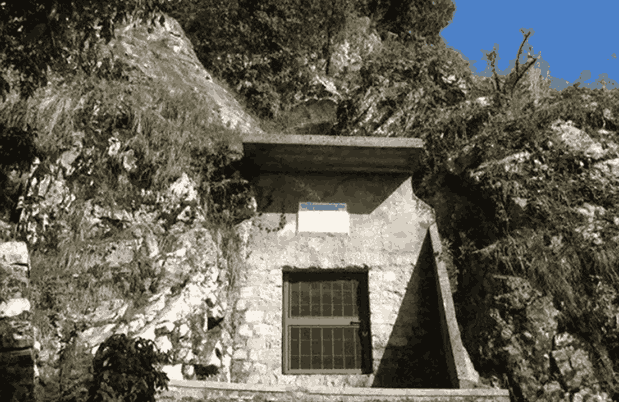
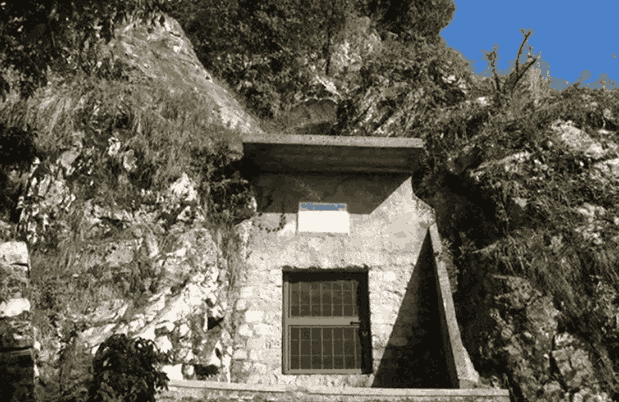
The cave itself is small. That is the first thing to understand. This is not a grand cavern, not a dramatic temple complex, not a place built to impress. It is a modest natural hollow in the rock of Dunagiri Mountain — intimate, cool, and quiet in a way that feels deliberately so. Shoes come off at the entrance. You step inside. And then — pilgrims struggle to describe what happens next without using words that seem too large for the context. A shrine to Babaji has been installed inside the cave, where visitors can offer flowers or simply sit in stillness. There is space for a small group to sit in meditation at a time, and pilgrims typically rotate in shifts if the group is large. The cave is open from 8 AM to 4 PM, and the advice from experienced pilgrims is always the same: arrive early, spend as long as you possibly can inside, and do not rush the return.
What Pilgrims Actually Experience Inside
This section does not pretend to explain what happens inside Babaji's Cave — because nobody can. What it can do is gather what pilgrims themselves have described, across years of accounts from Kriya Yogis, spiritual seekers, and ordinary travellers who arrived without any particular expectation and left with something they did not have before.
The Silence
Almost every account begins with the silence. Not the ordinary quiet of a remote mountain trail — something qualitatively different. Pilgrims describe the cave's atmosphere as 'otherworldly' and 'extraordinarily tranquil,' as though the air itself has a different texture. One visitor wrote of arriving to find only birdsong on the mountain, and feeling as though 'a few yogis are still meditating in their subtle bodies there, and the world is oblivious to them.
The Meditation
Most visitors spend anywhere from thirty minutes to two hours sitting inside the cave. Kriya Yoga practitioners typically go into formal practice. Those without a formal technique simply sit, breathe, and observe. What multiple accounts share is the quality of the stillness that settles — thoughts that normally crowd the mind becoming quieter, a deepening of whatever inner experience the person was capable of at that moment. One meditator described the sensation of being 'on another planet — full of joy and peace,' the cold of the cave entirely forgotten. What is notable is that this experience is not limited to advanced practitioners. Travellers who arrived as curious non-believers, or as companions of more devout pilgrims, consistently describe a quality of calm in the cave that they could not fully attribute to the setting alone. One described sitting for two hours — meditating, praying, simply being present — and experiencing 'a deep sense of peace and clarity I had never felt before. It was as if the veil between the physical and the spiritual had thinned.'
What Babaji's Presence Means Here
It is worth being honest about this. Babaji is described in the tradition as a deathless yogi who may or may not choose to make himself visible to a seeker — and never on demand. Coming to the cave and expecting a vision or a direct encounter is not the point, and the tradition itself cautions against such expectation. What the cave offers is the possibility of sitting in a place that carries centuries of accumulated spiritual intention — where Babaji chose to dwell, where Lahiri Mahasaya was transformed — and allowing whatever that means for you to unfold at its own pace.
Practical Information for Your Visit
Before planning independently, make sure you understand the Adi Kailash registration process, as permits and documentation may be required depending on your route.For international travelers, it is also important to check whether foreigners are allowed in Adi Kailash and Om Parvat before making arrangements.
How to Reach Kukuchina
- From Delhi: Approximately 400 km. Train to Kathgodam, then road via Ranikhet and Dwarahat to Kukuchina. Allow 10 to 12 hours total.
- From Kathgodam: Road journey of approximately 120 km via Ranikhet and Dwarahat — around 4 hours.
- From Dwarahat: 25 km by road to Kukuchina — approximately 50 minutes by taxi or shared jeep
- From Rishikesh: Via Almora and Ranikhet to Dwarahat, then onward to Kukuchina. Allow 7 to 8 hours.
- Nearest airport: Pantnagar Airport (limited connectivity). Jolly Grant Airport, Dehradun is an alternative with broader flight options.
- On the Nagarjuna Travels package: Transfer to Kukuchina is arranged as part of the itinerary on the return leg from Adi Kailash.
Cave Timings and Entry
- Open daily: 8 AM to 4 PM
- No entry fee
- Remove shoes before entering the cave
- No photography inside the cave is the expected practice — follow the group norm and your own sense of what is appropriate
- The cave can accommodate a small group at a time; if your group is large, plan to rotate in shifts of 20 to 30 minutes
What to Carry
- Sturdy walking shoes with good grip — the trail is steep in sections
- At least 1 litre of water per person
- Light snacks or energy bars — nothing elaborate is available on the trail
- A shawl or warm layer — the cave is cool even in summer months
- A small offering (flowers, incense) if that feels appropriate to you
- Your own meditation cushion or a fold of cloth to sit on
- Personal medication — the nearest pharmacy is in Dwarahat
Why This Stop Belongs at the Heart of the Journey
The Adi Kailash Yatra gives you the outer Himalaya at its most dramatic — Om Parvat's natural Om, the silence of Jyolingkong, the sheer scale of the peaks around Gunji. These are experiences that command the senses, that arrive from outside and fill you.
Babaji's Cave offers something else. It is small, inward, and quiet. It does not perform for you. What it offers is only available to the extent that you bring stillness to it — which is, of course, precisely the point. After the enormity of Adi Kailash and Om Parvat, arriving at this humble hollow in the rock of Dunagiri Mountain and sitting in silence is a different kind of experience. Not lesser — different. Complementary. The outer and the inner, held together in one pilgrimage. That is why Nagarjuna Travels includes this stop in their signature Adi Kailash package. One line in the itinerary. Several hours in practice. A visit that pilgrims consistently describe as the one they carry longest when they return home.