



- India Travelogue
- @Nagarjuna_Travels
Every devoted Shiva bhakt dreams of completing the 12 Jyotirlinga Yatra — a pilgrimage to all 12 sacred abodes of Lord Shiva spread across India. But when you actually sit down to plan it, the reality hits hard. The temples are scattered from Gujarat to Jharkhand, Tamil Nadu to Uttarakhand. How do you sequence them? What is the total distance? Which route makes geographic and logistical sense? Most guides give you a list of names — nothing more. This guide is different. You will find the complete 12 Jyotirlinga route map with distances between each temple, the most efficient circuit sequence, state-wise location breakdowns, travel modes, and a practical planning framework — whether you want to complete the yatra in one extended journey or visit temples region by region across multiple trips. The 12 Jyotirlingas are not just temples. They are the 12 points on earth where Lord Shiva is believed to have manifested as a column of infinite light — the Jyotirlinga. Undertaking this pilgrimage is considered one of the most meritorious acts in the Hindu tradition. Let this guide make it possible for you.
What Are the 12 Jyotirlingas? A Quick Overview
The 12 Jyotirlingas are the most sacred shrines of Lord Shiva in Hinduism. The Sanskrit word 'Jyotirlinga' translates as 'radiant sign of Shiva' — jyoti meaning light or radiance, and linga referring to the iconic cylindrical symbol of Shiva. According to the Shiva Purana, Lord Shiva appeared as a limitless pillar of light at each of these 12 locations to assert his supremacy and answer the devotion of his worshippers. The ancient verse that names all 12 Jyotirlingas — the Dwadasha Jyotirlinga Stotram — is recited daily by Shiva devotees across India. Visiting all 12 is believed to bestow the merit of a lifetime of spiritual practice and liberate the devotee from the cycle of rebirth.
All 12 Jyotirlingas: Location, State, and Key Details
Below is the complete list of all 12 Jyotirlingas with their precise locations, nearest cities, and key travel facts — the essential foundation for building your 12 Jyotirlinga route map.
1.Somnath Jyotirlinga Shri Somnath Mahadev Temple
Location: Prabhas Patan, Veraval State: Gujarat Nearest City / Distance: Veraval (1 km) | Junagadh (85 km) | Ahmedabad (400 km) Altitude: Sea Level | Access: Road / Rail (Veraval Station) Key Significance: First among the 12 Jyotirlingas. Faces the Arabian Sea. Rebuilt 17 times after repeated invasions. Present structure consecrated in 1951 by Sardar Vallabhbhai Patel.
2.Mallikarjuna Jyotirlinga Shri Mallikarjuna Swamy Temple
Location: Srisailam, Nallamala Hills State: Andhra Pradesh Nearest City / Distance: Hyderabad (213 km) | Kurnool (150 km) Altitude: 457 m | Access: Road / Helicopter from Hyderabad Key Significance: Located on the Nallamala Hills on the banks of Krishna River. One of the 18 Shakti Peethas also present here. The only site where both a Jyotirlinga and a Shakti Peetha exist.
3.Mahakaleshwar Jyotirlinga Shri Mahakaleshwar Temple
Location: Ujjain, Shipra River Banks State: Madhya Pradesh Nearest City / Distance: Ujjain city centre (0.5 km) | Indore (55 km) Altitude: 491 m | Access: Road / Rail (Ujjain Junction) Key Significance: The only south-facing (Dakshinamukhi) Jyotirlinga. Famous for Bhasma Aarti — a pre-dawn ritual using sacred ash. Located in the ancient city of Ujjain, one of the 7 sacred cities of India.
4.Omkareshwar Jyotirlinga Shri Omkareshwar & Mamleshwar Temple
Location: Mandhata Island, Narmada River State: Madhya Pradesh Nearest City / Distance: Indore (77 km) | Khandwa (70 km) Altitude: 190 m | Access: Road / Rail (Omkareshwar Road Station) Key Significance: Sits on an island naturally shaped like 'Om'. Two lingas — Omkareshwar and Mamleshwar — together constitute one Jyotirlinga. Associated with Adi Shankaracharya's spiritual initiation.
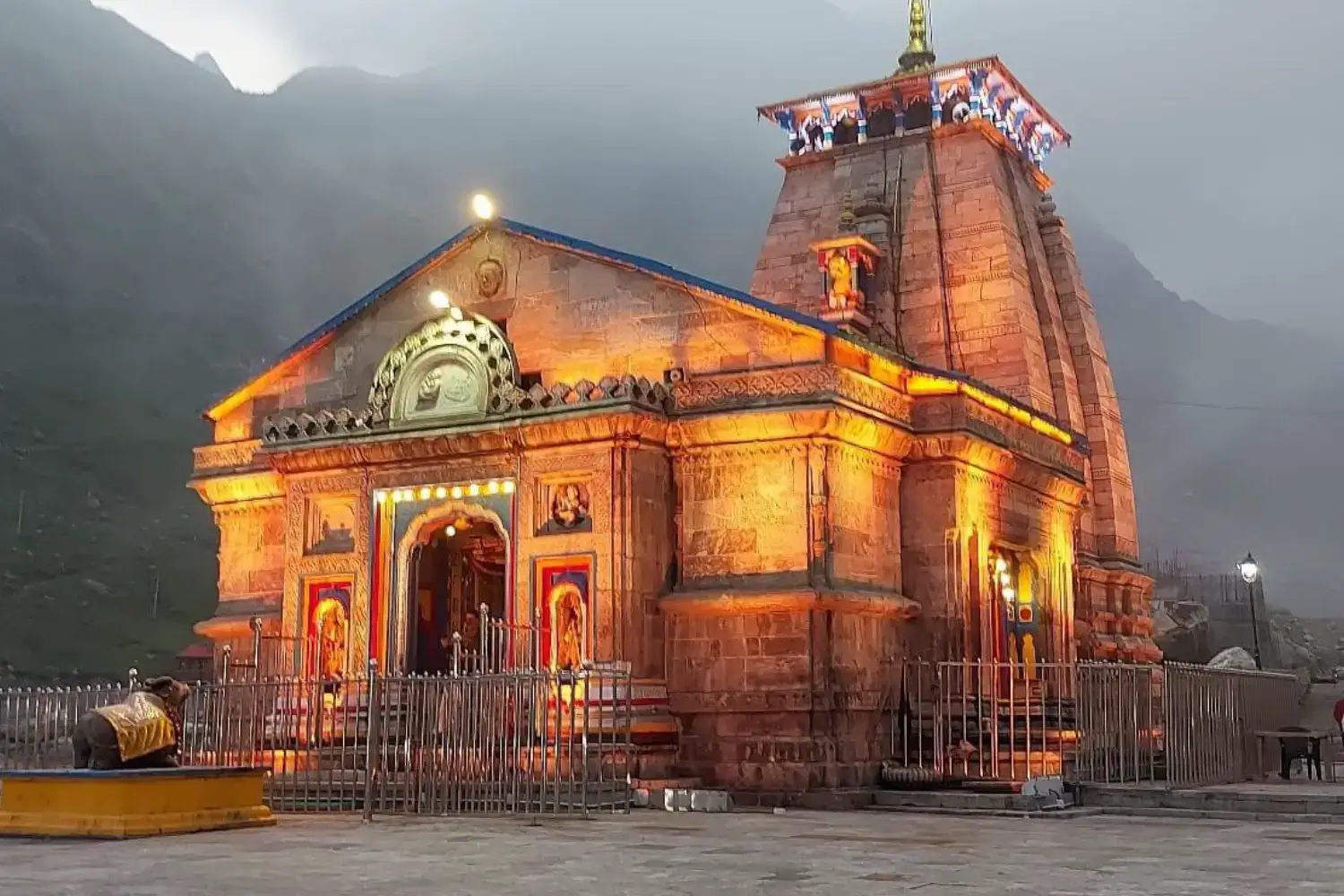
5.Kedarnath Jyotirlinga Shri Kedarnath Temple
Location: Kedarnath, Rudraprayag district State: Uttarakhand Nearest City / Distance: Gaurikund (16 km trek base) | Rishikesh (229 km) | Dehradun (270 km) Altitude: 3,583 m | Access: Trek from Gaurikund (16 km) / Helicopter Key Significance: Highest among the 12 Jyotirlingas at 3,583 m. Open only May–October (closed in winter due to heavy snowfall). Part of the Char Dham Yatra. The only Jyotirlinga requiring a significant mountain trek.
6.Bhimashankar Jyotirlinga Shri Bhimashankar Temple
Location: Bhimashankar, Sahyadri Range State: Maharashtra Nearest City / Distance: Pune (110 km) | Mumbai (200 km) Altitude: 1,050 m | Access: Road (winding Ghats road from Pune) Key Significance: Source of the Bhima River. Surrounded by dense Sahyadri forest — now a wildlife sanctuary home to the Giant Indian Squirrel. Nagara-style temple architecture.
7.Kashi Vishwanath Jyotirlinga Shri Kashi Vishwanath Temple
Location: Varanasi (Kashi), Ganga River Banks State: Uttar Pradesh Nearest City / Distance: Varanasi city (0.5 km) | Prayagraj (120 km) Altitude: 80 m | Access: Road / Rail / Air (Varanasi Airport – Lal Bahadur Shastri International) Key Significance: Most famous Jyotirlinga. Located in Varanasi — the oldest living city on earth. The Kashi Vishwanath Corridor (2021) transformed the temple complex significantly. Dying in Kashi is believed to grant moksha.
8.Trimbakeshwar Jyotirlinga Shri Trimbakeshwar Temple
Location: Trimbak, near Nashik State: Maharashtra Nearest City / Distance: Nashik (28 km) | Mumbai (170 km) | Pune (160 km) Altitude: 950 m | Access: Road from Nashik (40 mins) Key Significance: Source of the sacred Godavari River. The Jyotirlinga here has three faces — representing Brahma, Vishnu, and Shiva (the Trimurti). Kumbh Mela is held at Nashik every 12 years.
9.Vaidyanath Jyotirlinga Shri Vaidyanath Dham Temple
Location: Deoghar, Santhal Parganas State: Jharkhand Nearest City / Distance: Deoghar city (0.2 km) | Jasidih Junction (7 km) | Ranchi (250 km) Altitude: 254 m | Access: Road / Rail (Jasidih Junction) Key Significance: Also called Baidyanath Dham. One of the most visited Jyotirlingas — lakhs of Kanwariyas (Shiva devotees) walk barefoot from Sultanganj (105 km) carrying Ganga water during Shravan month.
10.Nageshwar Jyotirlinga Shri Nageshwar Mahadev Temple
Location: Dwarka, Saurashtra Coast State: Gujarat Nearest City / Distance: Dwarka (17 km) | Jamnagar (130 km) Altitude: Sea Level | Access: Road from Dwarka Key Significance: Features a massive 25-metre statue of Lord Shiva in the temple courtyard. Located near Dwarka — one of the 4 sacred dhams of Hinduism. Often combined with Dwarka temple visit.
11.Rameshwaram Jyotirlinga Shri Ramanathaswamy Temple
Location: Pamban Island, Rameswaram State: Tamil Nadu Nearest City / Distance: Rameswaram city (0.5 km) | Madurai (175 km) | Chennai (575 km) Altitude: Sea Level | Access: Road / Rail (Rameswaram Station) via Pamban Bridge Key Significance: Southernmost Jyotirlinga. Built by Lord Rama before crossing to Lanka. Features the world's longest temple corridor (1,212 m). One of the 4 Char Dhams. The temple has 22 sacred wells (theerthams).
12.Grishneshwar Jyotirlinga Shri Grishneshwar Temple
Location: Verul (Ellora), Aurangabad district State: Maharashtra Nearest City / Distance: Aurangabad (29 km) | Ellora Caves (1 km) | Mumbai (335 km) Altitude: 626 m | Access: Road from Aurangabad Key Significance: Last among the 12 Jyotirlingas. Located adjacent to the UNESCO World Heritage Ellora Caves. A pilgrimage here is often combined with a visit to Ajanta and Ellora.

12 Jyotirlinga Distance Chart: Temple to Temple
The table below shows the recommended circuit sequence for the 12 Jyotirlinga Yatra with the approximate road distance and travel time between each consecutive temple. The sequence is optimised for minimum total distance when travelling clockwise from Gujarat across India.
| From | To | Distance | Travel Time |
|---|---|---|---|
| Delhi / Mumbai | Somnath (Gujarat) | Mumbai: 890 kmDelhi: 1,380 km | 14–16 hrs |
| Somnath | Nageshwar (Dwarka) | 245 km | 4–5 hrs |
| Nageshwar | Omkareshwar | 530 km | 9–10 hrs |
| Omkareshwar | Mahakaleshwar (Ujjain) | 133 km | 2.5–3 hrs |
| Mahakaleshwar | Bhimashankar | 580 km | 10–11 hrs |
| Bhimashankar | Trimbakeshwar | 170 km | 3–4 hrs |
| Trimbakeshwar | Grishneshwar | 165 km | 3.5–4 hrs |
| Grishneshwar | Mallikarjuna (Srisailam) | 490 km | 9–10 hrs |
| Mallikarjuna | Rameshwaram | 730 km | 12–14 hrs |
| Rameshwaram | Kashi Vishwanath | 2,100 km | 28–32 hrs |
| Kashi Vishwanath | Vaidyanath (Deoghar) | 400 km | 6–8 hrs |
| Vaidyanath | Kedarnath | 860 km + 16 km trek | 14–16 hrs drive + 6–8 hrs trek |
| Kedarnath | Delhi | 270 km | 5–6 hrs |
total Circuit Distance: Approximately 8,000 – 10,000 km depending on the exact route and detours taken. The longest single leg is Rameshwaram to Varanasi (~2,100 km) — ideally covered by overnight express train to save both time and cost. The shortest legs (Somnath–Nageshwar, Omkareshwar–Mahakaleshwar) can be covered comfortably in half a day each.
12 Jyotirlinga Route Map: 4 Regional Clusters
Not everyone can undertake all 12 Jyotirlingas in a single journey. The most practical approach is to divide the route into 4 regional clusters — each completable in 4–7 days as a standalone pilgrimage. Over time, completing all 4 clusters means completing the full 12 Jyotirlinga Yatra.
CLUSTER 1 — WESTERN INDIA | Gujarat (2 Jyotirlingas)
Both Gujarat Jyotirlingas sit on the Saurashtra coast and can be combined easily in a 2–3 day road trip. Ahmedabad or Rajkot serve as ideal base cities.
| Temple | Location | Distance from Ahmedabad | Suggested Days |
| Somnath | Veraval, Gir Somnath | 395 km (5–6 hrs) | Day 1–2 |
| Nageshwar | Dwarka | 430 km from Ahmedabad 245 km from Somnath | Day 2–3 |
CLUSTER 2 — CENTRAL INDIA | Madhya Pradesh & Maharashtra (5 Jyotirlingas)
Central India has the highest concentration of Jyotirlingas. Five sacred temples can be covered in a well-planned 7–9 day circuit based out of Indore, Pune, or Aurangabad.
| Temple | State | Distance Between Temples | Notes |
| Omkareshwar | Madhya Pradesh | Starting point of cluster | Base: Indore |
| Mahakaleshwar | Madhya Pradesh | 133 km from Omkareshwar | Base: Ujjain |
| Bhimashankar | Maharashtra | 580 km from Ujjain | Base: Pune |
| Trimbakeshwar | Maharashtra | 170 km from Bhimashankar | Base: Nashik |
| Grishneshwar | Maharashtra | 165 km from Trimbakeshwar | Base: Aurangabad |
CLUSTER 3 — SOUTH & EAST INDIA | AP, Tamil Nadu & Jharkhand (3 Jyotirlingas)
This cluster covers the longest geographic spread. Hyderabad serves as the ideal hub for connecting all three. Budget 6–8 days for this cluster.
| Temple | State | Distance | Notes |
| Mallikarjuna | Andhra Pradesh | 213 km from Hyderabad | Base: Hyderabad |
| Rameshwaram | Tamil Nadu | 730 km from Srisailam | Overnight train recommended |
| Vaidyanath | Jharkhand | 2,100 km from Rameswaram | Train from Chennai/Madurai |
CLUSTER 4 — NORTH INDIA | UP & Uttarakhand (2 Jyotirlingas)
The two North India Jyotirlingas are best visited together. Varanasi is the cultural and spiritual anchor; Kedarnath requires a dedicated 3-day mountain excursion (open May–October only).
| Temple | State | Distance | Notes |
| Kashi Vishwanath | Uttar Pradesh | 400 km from Deoghar (JH) | Base: Varanasi |
| Kedarnath | Uttarakhand | 270 km from Varanasi + 16 km trek from Gaurikund | Open May–Oct only. Helicopter available. |
12 Jyotirlinga Location: State-Wise Summary
| State | Jyotirlingas | No. | Nearest Airport |
| Gujarat | Somnath, Nageshwar | 2 | Rajkot / Porbandar / Jamnagar |
| Madhya Pradesh | Mahakaleshwar, Omkareshwar | 2 | Indore (IDR) |
| Maharashtra | Bhimashankar, Trimbakeshwar, Grishneshwar | 3 | Pune (PNQ) / Mumbai (BOM) / Aurangabad (IXU) |
| Andhra Pradesh | Mallikarjuna (Srisailam) | 1 | Hyderabad (HYD) |
| Tamil Nadu | Rameshwaram | 1 | Madurai (IXM) |
| Uttar Pradesh | Kashi Vishwanath (Varanasi) | 1 | Varanasi (VNS) |
| Uttarakhand | Kedarnath | 1 | Dehradun (DED) then road |
| Jharkhand | Vaidyanath (Deoghar) | 1 | Deoghar (DGH — limited) / Ranchi (IXR) |
Final Thoughts: Begin Your 12 Jyotirlinga Journey
The 12 Jyotirlinga Yatra is one of the most ambitious and rewarding pilgrimages a devotee can undertake in India. Spread across 10 states, from the Arabian Sea coast of Gujarat to the snow-covered peaks of Uttarakhand, the route is a journey through the entire spiritual and geographic soul of India. Do not let the scale intimidate you. Start with your nearest regional cluster. Let each Jyotirlinga visit build your confidence and deepen your devotion. Whether you complete all 12 in one grand continuous circuit or across multiple trips over years — every single visit counts, every darshan is complete in itself. Use this 12 Jyotirlinga route map as your living planning document. Check distances. Book trains early. Time Kedarnath around May or September. And when you finally stand at the 12th temple — Grishneshwar, adjacent to the ancient Ellora Caves — you will understand why generations of devotees have called this yatra a journey that changes everything.